
Creating safe, respectful, and harassment-free workplaces is no longer optional — it is a legal, ethical, and cultural imperative. As companies strive to strengthen their PoSH compliance and uphold employee safety, Internal Committees (ICs) play a crucial role in ensuring fair investigations and meaningful corrective actions.
However, in my work with organisations across industries, I have observed a troubling trend:
one perpetrator repeatedly harassing multiple colleagues over a period of time.
Most ICs conclude the case with termination – and while this protects the immediate workplace, a deeper question arises:
Are we solving the problem… or simply relocating it?
When a guilty individual is terminated without any behavioural reform, the risk doesn’t go away.
An unreformed perpetrator is released into society, potentially joining another organisation and continuing the same pattern of harassment.
As experts committed to safe work cultures, our responsibility must go beyond punitive action.
We must focus on rehabilitation, behavioural correction, and long-term risk mitigation.
This is why I strongly advocate that ICs consider mandating counselling for perpetrators of sexual harassment, whether or not they remain employed.
Below are three essential questions organisations must evaluate carefully.
Are counselling therapies like CBT and relapse-prevention models effective for perpetrators of sexual harassment?
Research across behavioural sciences, criminal psychology, and workplace misconduct studies shows that structured counselling – particularly Cognitive Behavioural Therapy (CBT) – is effective in addressing the root causes of inappropriate behaviour.
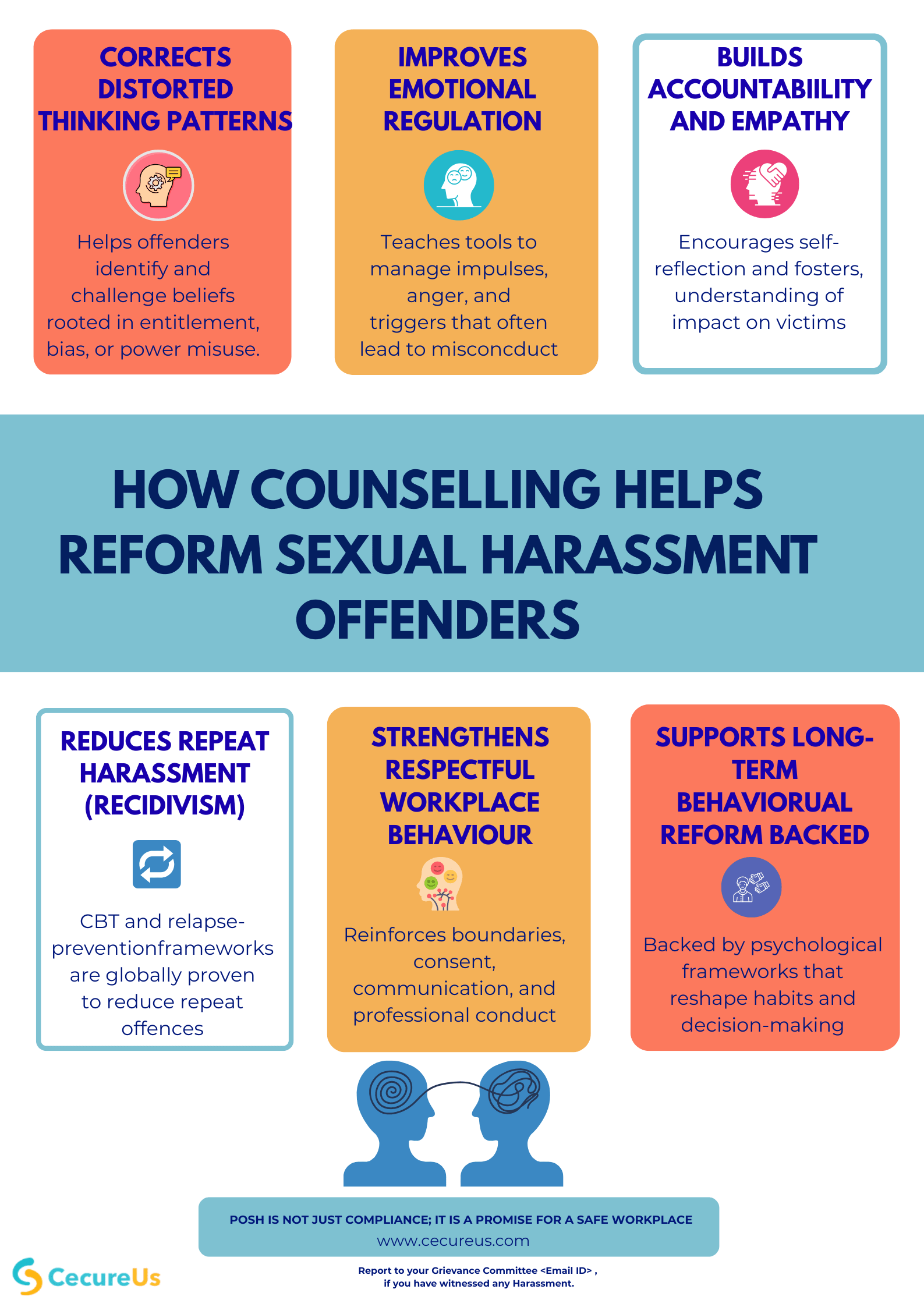
CBT and relapse-prevention programs help offenders:
- Identify and reframe distorted thinking patterns
- Understand power dynamics and entitlement beliefs
- Recognize emotional and behavioural triggers
- Build empathy and accountability
- Develop healthier behavioural alternatives
These evidence-based therapies are widely used for preventing repeat sexual offences and workplace misconduct. While not a standalone cure, counselling provides a structured path toward behavioural change – something termination alone cannot achieve.
Can counselling reduce repeat harassment? How many sessions are typically required?
Yes – counselling can significantly reduce recidivism among sexual offenders when delivered through a consistent, structured program.
Key findings from global research:
- Long-term, multi-session interventions are far more effective than one-off sessions
- CBT-based treatment models show measurable reductions in repeat sexual harassment and misconduct
- Behavioural reform often requires 8–20 sessions or more, depending on the nature and severity of the behaviour
- The offender’s willingness to participate is the strongest predictor of success
Counselling is most effective when the goal is not only to correct behaviour, but to reshape the mindset that led to the harassment.
If the IC mandates counselling, can counsellors provide progress reports to the IC or management?
Yes – with boundaries.
While counsellors must maintain confidentiality, they can provide structured progress summaries when counselling is mandated as part of corrective action under the PoSH framework. These updates typically include:
- Attendance and participation levels
- Willingness to engage and reflect
- Observable behavioural shifts or persistent challenges
- Recommendations for continued support or risk mitigation
High-level reports ensure ethical transparency while enabling organisations to make informed decisions about safety, reintegration, or separation.
Confidentiality is respected – and workplace safety is preserved.
Why Mandating Counselling Is a Responsible Organisational Practice
Simply terminating a harasser may feel like a clean solution, but it does not address the behavioural issue at its core.
To truly break the cycle of harassment, organisations must adopt a more holistic approach.
Mandated counselling helps:
- Reduce the risk of repeated harassment
- Address underlying behavioural and psychological factors
- Reinforce organisational commitment to responsible PoSH implementation
- Protect future workplaces and communities
- Build a culture of accountability and reform—not just compliance
A workplace becomes safer not just by removing misconduct, but by preventing its recurrence.
Instead of discarding the “bad apple,” we must invest in understanding and correcting the behaviour – for the sake of all workplaces that individual may enter in the future.
Conclusion
As organisations mature in their PoSH implementation, it is time to expand the IC lens from punitive measures to preventive and rehabilitative strategies. Counselling is not a soft option – it is a scientifically grounded, ethically responsible, and legally permissible corrective tool.
By mandating counselling for perpetrators, we not only ensure justice within our organisations but also contribute to building safer workplaces across society.