Case Scenario
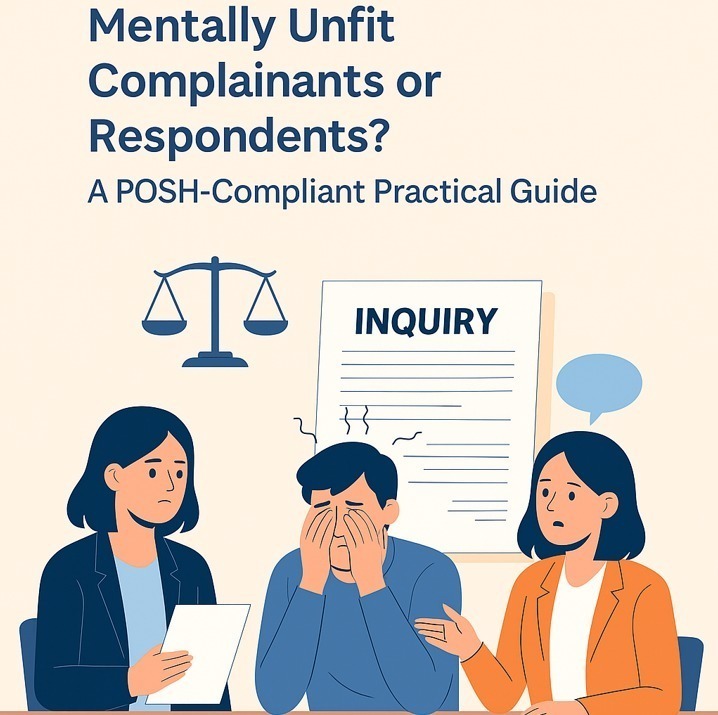
During a PoSH awareness session at a tech firm, an employee, Aarti, files a formal sexual harassment complaint against her colleague, Rajeev, a senior technical analyst. The complaint alleges that Rajeev repeatedly made sexually suggestive jokes and invaded her personal space, despite her verbal objections.
When the Internal Committee (IC) reaches out to Rajeev for his response, they observe that he is unable to focus, provides inconsistent answers, and appears highly disoriented. Over the course of the proceedings, Rajeev exhibits signs of mental instability — including memory lapses, emotional breakdowns, and confused statements. His reporting manager informs the IC that Rajeev has been undergoing treatment for bipolar disorder and had recently experienced a relapse.
The IC now faces a dilemma: how to conduct a fair, unbiased inquiry that respects due process while accommodating Rajeev’s mental health condition.
Introduction
The redressal mechanism under India’s Prevention of Sexual Harassment (PoSH) Act is designed to ensure a safe, inclusive, and equitable work environment. However, Internal Committees may sometimes deal with parties who are mentally unfit — either temporarily or chronically. In such cases, ICs must balance legal compliance with natural justice, and adopt a trauma-informed and inclusive approach.
Recognizing and Handling Mental Unfitness: A Practical Guide for the IC
Identifying Signs of Mental Unfitness:
ICs should remain vigilant for signs like:
- Incoherent or delusional statements
- Memory loss or inability to recall key facts
- Emotional breakdowns or outbursts
- Aggressive or self-harming behavior
- Paranoia or hypervigilance
These can manifest:
- At the time of the incident
- During the inquiry process
Legal Provision for Support:
If a complainant is mentally unfit, Rule 6(2) of the PoSH Rules permits:
- A legal heir
- A guardian
- A member of the IC
to help file the complaint.
For respondents, while not explicitly covered in PoSH, their condition can affect proceedings significantly — from not understanding the nature of their actions to being unable to defend themselves.
Seeking Medical Evaluation and Documentation:
The IC should:
- Seek a psychiatric assessment from a licensed mental health professional
- Request a fitness certificate for participation in inquiry
- Obtain informed consent
- Take expert help in framing trauma-informed questions
This ensures fair participation and defensible outcomes.
Accommodating Mentally Unfit Parties:
ICs must:
- Allow a support person or guardian (as per the Mental Healthcare Act, 2017)
- Accept written statements if verbal communication is difficult
- Record the presence of the support person, ensuring no influence on testimony
Assessing Fitness to Participate in Inquiry:
Key criteria include the ability to:
- Understand the complaint
- Follow proceedings
- Articulate a defense
- Understand and respond to evidence
- Interact with witnesses and the IC
If unfit, modify procedures:
- Use simple, clear language
- Conduct shorter sessions in safe spaces
- Allow guardian-submitted testimony
- Validate all facts with corroborative evidence
- Ensure no bias or prejudgment
Maintaining Dignity and Confidentiality:
ICs must:
- Maintain confidentiality of medical information
- Avoid stigma, labels, or assumptions
- Be empathetic yet neutral in all interactions
Proceeding with Caution:
If the party is medically unfit to participate:
- Temporarily suspend the inquiry
- Notify management confidentially
- Seek legal guidance
- Resume after fitness is restored or defer indefinitely
All actions must be properly documented.
Documentation Checklist:
Maintain:
- Medical records and certificates
- Guardian/support person records
- Procedural adjustments made
- Meeting notes and internal correspondence
- Reasoning behind all IC decisions
Relevant Legal Provisions:
- Section 9(2), PoSH Act – Extension of 3 months to file complaint in genuine cases of incapacity
- Rule 6(2), PoSH Rules – Assistance in filing complaints for mentally/physically unfit complainants
- Rule 9, PoSH Rules – Allows recommendation of counselling
- Section 12, PoSH Act – Interim relief during pendency of inquiry
- Section 13, PoSH Act – Recommendations after inquiry
- Section 367, BNSS (2023) – Suspension of trial for unsound mind
- Section 84, BNS (2023) – Acts committed by persons of unsound mind may not attract criminal liability
Returning to Rajeev’s Case: What Should the IC Do?
- Refer Rajeev for psychiatric evaluation
- Modify proceedings (shorter, written responses, support person)
- Recommend counselling under Rule 9
- Provide interim protection to Aarti under Section 12
- If unfit, suspend proceedings and document it
- Resume after medical fitness is confirmed.
If Rajeev is Found Guilty
Under Section 13, the IC may recommend:
- Written apology
- Counselling or psychiatric help
- Withholding promotions or increments
- Transfer to another team
- Termination in severe or repeat cases
- Mandatory sensitization training
All actions should be proportionate and justified based on severity and mental health context.
Conclusion
Handling PoSH cases involving mentally unfit individuals requires:
- Legal clarity
- Medical sensitivity
- Empathy without prejudice
- Thorough documentation
- Clear communication
ICs must uphold dignity, fairness, and safety for all.
Please reach out to us for any queries on What to do when the Complainants or Respondents are Mentally Unfit.
For more blogs and articles, visit our official website. Contact us for workshops and queries related to POSH, EAP (Employee Assistance Program) , Diversity and Inclusion and Code Of Conduct.