
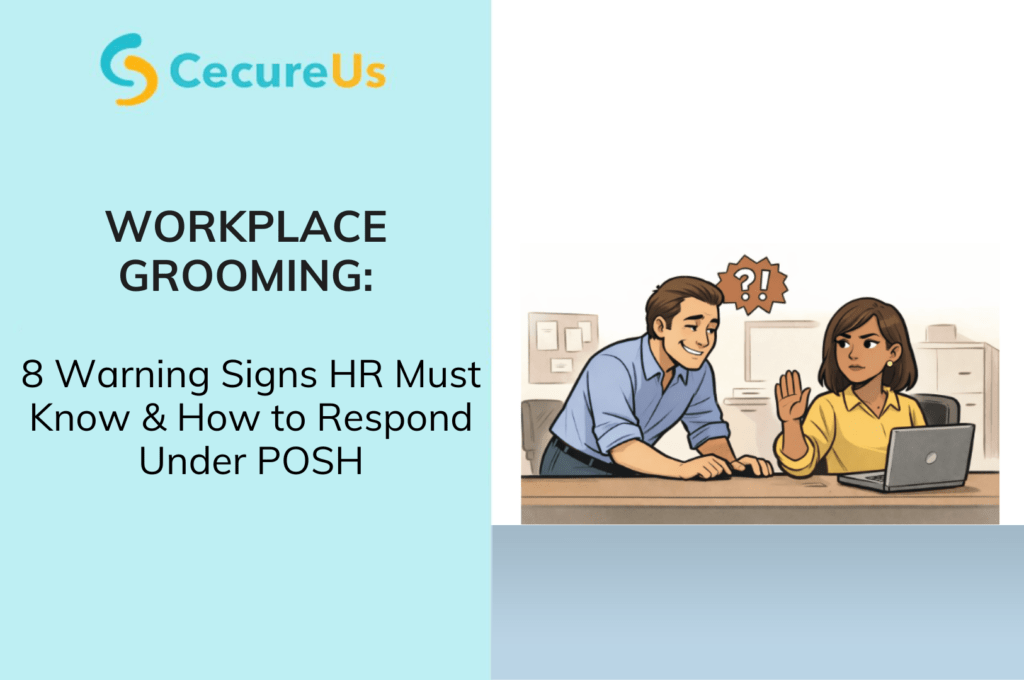
| Workplace grooming is when a colleague — usually someone senior — slowly builds a one-sided, dependent relationship with someone junior through special attention, favours, or flattery, with the eventual goal of crossing a boundary. It is not a single incident but a pattern of behaviour that is deliberately subtle and hard to name. The 8 warning signs in this article will help HR managers, IC members, and employees identify grooming before it escalates — and know exactly when and how to act. |
When people hear the phrase grooming behavior, they often think it has something to do with appearance, neatness, or hygiene. But in the workplace it means something completely different. It refers to subtle actions someone uses to blur boundaries, gain influence, or create a sense of obligation. It usually starts quietly which is why so many people miss the early signs.
Grooming behavior is not always dramatic. It often comes wrapped in friendliness, praise, or offers to help. Sometimes it even looks supportive at first. But the intention behind it is to slowly shift power and control in a relationship. Awareness is what helps employees stay grounded and confident in how they respond.
Let us walk through what grooming looks like in real life, and what you can do if you ever find yourself in one of these situations.
Common Grooming Behaviors at Work
Special attention that seems excessive:
Someone suddenly becomes unusually invested in one person but not others. They check in constantly, show up uninvited, or offer help that feels unnecessary.
Example:
A team member keeps stopping by a colleague’s desk with small gifts or treats even after being told it is not needed.

Comments that cross professional comfort levels:
These are the comments that make someone pause. They may sound like compliments, but they feel too personal or repeated too often.
Example:
A coworker repeatedly tells someone they look great today even though the person clearly does not enjoy the remarks.

Creating a sense of obligation:
This is one of the most common grooming tactics. The person reminds others of favors they did and uses this to pressure them into doing things they normally would decline.
Example:
“Remember when I stayed late to help you finish that report. You should really help me with this project today.”
Isolating the person through private conversations:
They push for private chats, after hours calls, or one on one meetings that are not necessary for the role.
Example:
They insist a discussion must be handled privately even though it involves work tasks that could easily be discussed in the team.
Realistic Workplace Scenarios
Scenario 1 – Creating a sense of obligation
Riya’s coworker constantly reminds her of the time he helped her finish a deadline. Now he pressures her to stay late to help him with unrelated tasks. She feels cornered and worries that saying no will seem ungrateful.
What Riya can do:
* Politely but firmly set limits.
* Say something simple like “I appreciate the help that day, but I cannot commit to this.”
* Document the pattern to notice if it continues.
* Speak to her manager early if she feels pressured again.
Scenario 2 – Documenting and raising concerns
After weeks of pressure, Riya notices the pattern repeating. She begins writing down dates, comments, and situations. She then speaks to HR to describe how the behavior makes her feel.
Why this helps:
Documentation brings clarity. It creates a timeline. It shows the difference between a one time favor and repeated pressure. It allows HR to act with clear information.
Scenario 3 – Witness support
Riya’s teammates start noticing the uncomfortable interactions. Instead of ignoring them they check in. They validate her feelings and offer to join meetings or be present whenever she needs.
Why this matters:
Support reduces fear. It helps the person feel seen and not isolated. A witness offering to be present can stop grooming patterns from escalating.
How Employees Can Respond
- Trust your instincts – If something feels off it usually is. Discomfort is a helpful signal.
- Set clear boundaries – Simple statements like “I prefer to keep this professional” or “I am not comfortable with this” are enough. Boundaries do not require long explanations.
- Limit unnecessary one on one interactions – If private conversations feel pressured, ask to include another colleague or move the discussion to a visible space.
- Document what happens – Write down dates, comments, and circumstances. Documentation keeps emotions separate from facts.
- Speak early with HR or a manager – You do not need proof. You only need to express concern. The earlier the conversation happens, the easier it is to address.
How Colleagues Can Help
* Pay attention to dynamics that feel unbalanced
* Ask the person if they want support in meetings
* Speak up if you notice boundary crossing
* Encourage them to talk to HR
* Reinforce that their feelings are valid
Supportive teams create psychological safety long before problems escalate.
Final Thoughts
Grooming behavior does not always arrive as a large problem. It often begins with small moments that feel slightly uncomfortable. The goal is not to become suspicious of everyone but to stay aware of patterns that gradually cross personal and professional boundaries.
Healthy workplaces are built on clarity and respect.
Recognizing grooming behavior early allows people to stay confident, safe, and supported. When teams speak openly about these patterns everyone benefits.
For more blogs and articles, visit our official website. Contact us for workshops and queries related to POSH, EAP (Employee Assistance Program) , Diversity and Inclusion and Code Of Conduct.