
A Complete Guide for IC Members, HR Leaders, and POSH Professionals
When organizations discuss Prevention of Sexual Harassment (POSH) compliance, most conversations revolve around awareness training, complaint handling, witness interviews, and investigation procedures.
However, one critical aspect of the POSH inquiry process often receives far less attention than it deserves:
The POSH Inquiry Report.
A well-written inquiry report is not merely a summary of interviews or evidence collected during an investigation. It is the document that demonstrates whether the Internal Committee (IC) conducted a fair inquiry, followed the principles of natural justice, evaluated evidence objectively, and arrived at a reasoned conclusion.
In fact, the quality of the inquiry report often determines the credibility of the entire POSH investigation.
A weak report can undermine months of diligent investigation, expose the organization to legal challenges, create employee distrust, and raise serious questions about procedural fairness.
For Internal Committee members, HR leaders, Employee Relations professionals, and POSH practitioners, report writing is not an administrative task—it is one of the most important responsibilities under the POSH Act.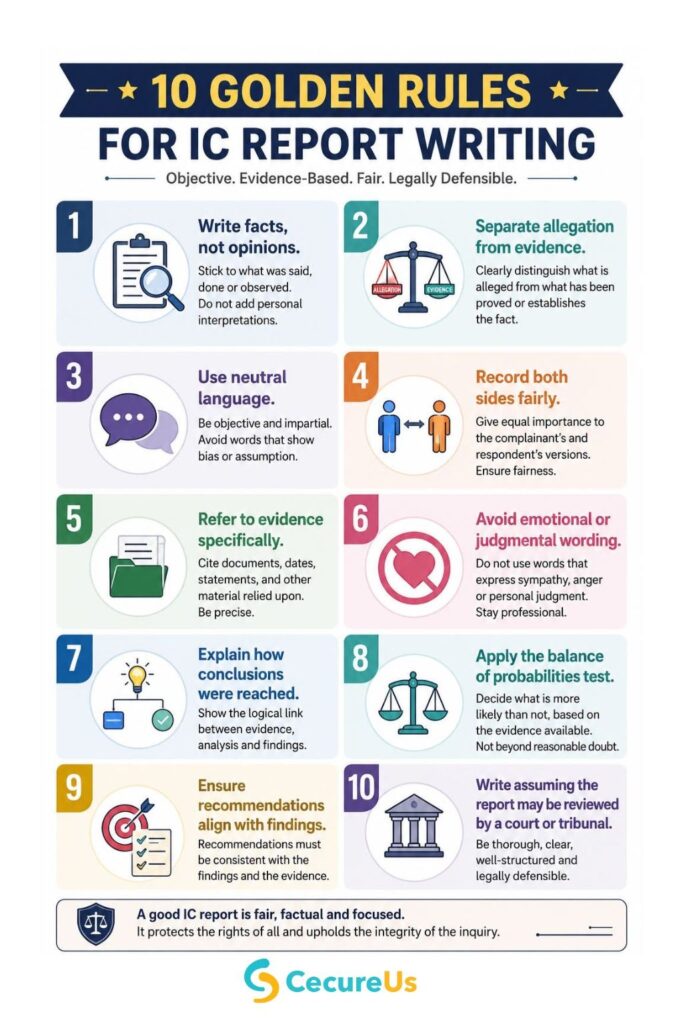
10 Golden Rules of POSH Inquiry Report Writing
Before signing off on an inquiry report, every Internal Committee member should remember these principles:
- Base Every Finding on Evidence
Conclusions must arise from evidence, not assumptions, personal opinions, or perceptions.
- Separate Allegations, Evidence, Analysis, and Findings
A professionally drafted report clearly distinguishes what was alleged, what evidence was reviewed, how it was analysed, and what findings were reached.
- Maintain Neutral and Objective Language
Avoid emotional, accusatory, or judgmental language. The report should remain factual and professional throughout.
- Record Both Parties’ Versions Fairly
A balanced report accurately documents the complainant’s and respondent’s submissions without distortion.
Each finding should be traceable to witness statements, documents, emails, messages, admissions, or other evidence reviewed during the inquiry.
- Address Contradictory Evidence
Strong inquiry reports acknowledge conflicting evidence and explain how it was evaluated.
POSH inquiries are civil proceedings. Findings should be based on what appears more likely than not after evaluating the available evidence.
- Follow Principles of Natural Justice
Both parties must receive a fair opportunity to present their case and respond to evidence.
- Align Recommendations with Findings
Disciplinary recommendations should logically flow from the findings recorded in the report.
- Write a Legally Defensible Report
The report should withstand scrutiny from employers, appellate authorities, labour courts, tribunals, or judicial forums.
Why the POSH Inquiry Report Matters
Under the Sexual Harassment of Women at Workplace (Prevention, Prohibition and Redressal) Act, 2013, the Internal Committee is required to submit its findings upon completion of an inquiry.
The inquiry report forms the basis on which:
- Employers determine disciplinary action.
- Parties assess whether the inquiry was fair.
- Appellate authorities review decisions.
- Courts examine procedural compliance and natural justice.
The inquiry report is therefore not a routine administrative document.
It is the foundation upon which organizational decisions, disciplinary actions, and legal defensibility rest.
A Good POSH Investigation Can Fail Because of a Poor Report
Imagine this situation:
An Internal Committee spends weeks reviewing emails, interviewing witnesses, analysing messages, and evaluating evidence.
The final report contains only one sentence:
“The Committee believes the complainant is telling the truth.”
Immediately, several questions arise:
- Why did the Committee reach that conclusion?
- What evidence supported the finding?
- Were inconsistencies examined?
- Was the respondent’s version fairly considered?
- How was credibility assessed?
Without documented reasoning, even an excellent investigation can appear arbitrary and biased.
The purpose of a POSH inquiry report is not simply to announce a conclusion.
Its purpose is to demonstrate how the Committee arrived at that conclusion.
Understanding the Difference Between Allegations, Evidence, Analysis and Findings
One of the most common mistakes in Internal Committee reports is treating allegations as findings.
A robust POSH inquiry report follows a logical structure:
Allegation
“The respondent repeatedly sent unwelcome messages.”
Evidence
Chat records, emails, screenshots, witness testimony, call logs, contemporaneous complaints, or admissions.
Analysis
Assessment of consistency, corroboration, credibility, contradictions, timelines, and surrounding circumstances.
Finding
Whether the allegation is substantiated based on the balance of probabilities.
This distinction is critical because findings must emerge from evidence—not assumptions.
Understanding the Balance of Probabilities Standard
Many IC members mistakenly apply criminal law standards while conducting POSH inquiries.
The applicable standard is not “beyond reasonable doubt.”
The applicable standard is the balance of probabilities.
The Committee must determine whether, after reviewing all available evidence, it is more likely than not that the alleged conduct occurred.
This is particularly important because workplace sexual harassment frequently occurs in private settings without direct witnesses.
Absence of CCTV footage does not automatically invalidate a complaint.
Similarly, absence of conclusive proof does not automatically establish innocence.
The Committee must evaluate the totality of evidence and explain why one version appears more probable than the other.
Common Mistakes That Weaken POSH Inquiry Reports
Using Emotional Language
Avoid phrases such as:
- “Clearly guilty”
- “Obviously dishonest”
- “Bad character”
Such language creates an appearance of bias.
Failing to Link Findings to Evidence
Every conclusion should have supporting evidence.
Ignoring Contradictory Evidence
A legally defensible report addresses both supporting and opposing evidence.
Making Assumptions
Committees should evaluate facts, not speculate on motives or intentions.
Copying Statements Without Analysis
Merely reproducing witness testimony is not analysis. The Committee must explain how the evidence influenced its findings.
What Makes a Strong Internal Committee Report?
A strong inquiry report:
✔ Demonstrates impartiality
✔ Records both parties’ versions fairly
✔ Evaluates evidence systematically
✔ Applies the balance of probabilities standard
✔ Explains the rationale behind findings
✔ Aligns recommendations with findings
✔ Reflects compliance with natural justice principles
Most importantly, it enables an independent reader to understand how and why the Committee reached its conclusions.
Before You Sign the Inquiry Report
Before signing a POSH inquiry report, every Internal Committee member should ask:
- Is this report evidence-based?
- Is it fair and unbiased?
- Is it legally defensible?
Your signature is not a formality.
It is a declaration that the inquiry was conducted fairly, evidence was evaluated objectively, findings were reasoned, and procedural requirements were followed.
Final Thoughts
The effectiveness of a POSH framework is not measured by the number of awareness sessions conducted or complaints closed.
It is measured by the fairness, integrity, and credibility of the inquiry process.
And nowhere is that credibility more visible than in the inquiry report.
Strong investigations lead to strong reports.
Strong reports lead to trust.
Trust leads to safer workplaces.
Write carefully.
Document objectively.
Sign responsibly.
Frequently Asked Questions (FAQs)
What is a POSH Inquiry Report?
A POSH Inquiry Report is the final report prepared by the Internal Committee after completing an inquiry into a workplace sexual harassment complaint.
Who prepares the POSH Inquiry Report?
The Internal Committee constituted under the POSH Act prepares and signs the inquiry report.
What standard of proof applies in a POSH inquiry?
The standard applied is the balance of probabilities, not beyond reasonable doubt.
Why is report writing important in POSH cases?
The report forms the basis for employer action, appellate review, and judicial scrutiny. Poor report writing can weaken an otherwise strong investigation.
Can a POSH inquiry report be challenged in court?
Yes. Courts often examine whether the Internal Committee followed natural justice, procedural fairness, and evidence-based decision-making while preparing the report.
Should the POSH Inquiry Report Be Shared with the Complainant and Respondent?
Yes. Under Section 13 of the POSH Act, the Internal Committee must provide its findings to the employer and the concerned parties. Sharing the report promotes transparency, procedural fairness, and enables parties to exercise their right to appeal.
Can an Employer Share Only the Outcome and Not the Full Inquiry Report?
No. Merely communicating the outcome is generally insufficient. The inquiry report contains the reasoning, analysis, and findings that form the basis of the decision. Sharing the report strengthens transparency and compliance with natural justice principles.
For more blogs and articles, visit our official website. Contact us for workshops and queries related to POSH, EAP (Employee Assistance Program) , Diversity and Inclusion and Code Of Conduct.