
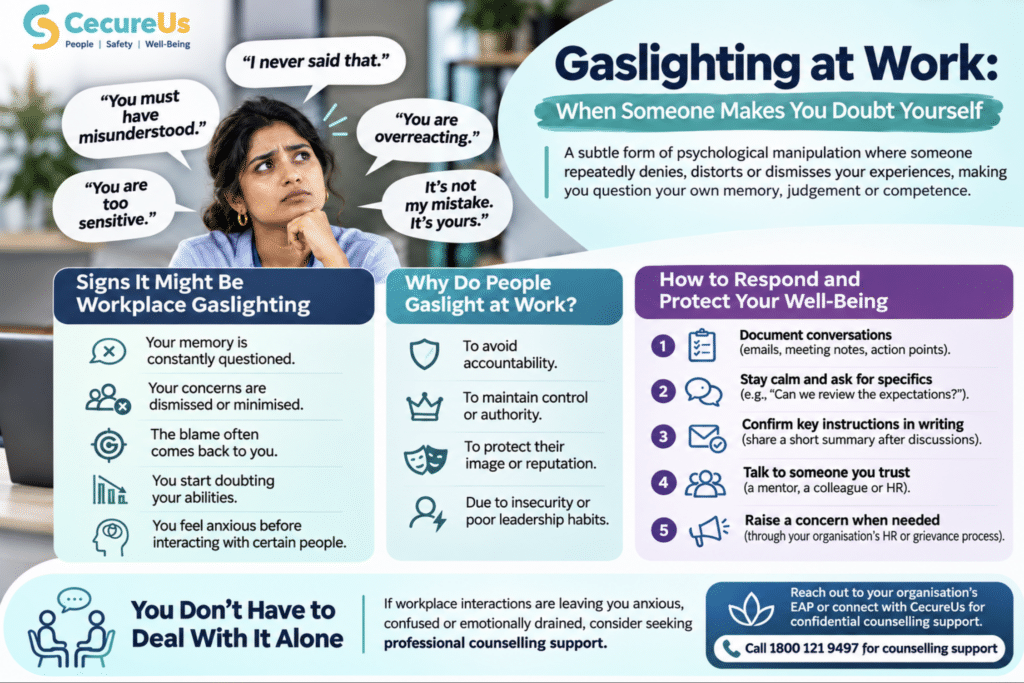
“I never said that.”
“You must have misunderstood.”
“Why do you always take things so personally?”
Sounds familiar?
Most of us have heard these statements at work at some point. Sometimes they come from a manager, sometimes from a colleague, and sometimes from someone we trust.
Now imagine hearing them repeatedly, especially when you are sure about what actually happened.
You begin questioning yourself.
Did I misunderstand the instructions? Am I being too sensitive? Is something wrong with me?
And slowly, you start losing confidence in your own judgement.
This could be workplace gaslighting.
What Does Gaslighting at Work Really Look Like?
Let me share a simple workplace situation.
Priya is a capable employee who has always received positive feedback about her work.
One Monday, her manager asks her to prepare a client presentation with specific information. She completes it and shares it within the deadline.
During the review, her manager says, “This is not what I asked for. You never seem to understand instructions.”
Priya is surprised. She remembers the conversation clearly. But rather than arguing, she apologises and reworks the presentation.
A few weeks later, something similar happens.
This time, when she tries to explain, her manager responds, “You are always so defensive. Learn to accept feedback.”
Over the next few months, Priya starts double checking every instruction, hesitating before speaking in meetings, and doubting decisions she would once have made confidently.
She begins to wonder if she is genuinely incompetent.
The problem is no longer just the work. It is what these repeated interactions are doing to her confidence.
When someone persistently denies, twists, or dismisses your experiences and makes you question your own memory or perception, it may be a form of psychological manipulation known as gaslighting.
Why Do People Gaslight Others at Work?
This is an important question.
Why would someone deliberately make another person doubt themselves?
Sometimes, it is to avoid admitting a mistake.
Sometimes, it is about maintaining authority or controlling how others perceive a situation.
And sometimes, it comes from insecurity, poor leadership habits, or an inability to accept being questioned.
For example, a manager who struggles to accept responsibility may repeatedly blame team members rather than acknowledge unclear instructions.
A colleague may deny an earlier agreement to escape accountability.
Not every person who does this is consciously trying to manipulate someone. But when the behaviour becomes a repeated pattern of distorting reality, its impact can be damaging.
How Can You Recognise Workplace Gaslighting?
Gaslighting does not always involve shouting, threats, or obvious bullying.
Often, it appears in everyday workplace conversations.
Here are some signs worth paying attention to.
- Your memory is constantly questioned
You clearly remember an instruction or conversation, but someone repeatedly insists it never happened.
- Your concerns are dismissed
Whenever you raise an issue, you are told that you are overreacting, imagining things, or being too emotional.
- The blame always comes back to you
Even when responsibilities are unclear or mistakes are shared, you somehow end up being blamed.
- You start doubting your abilities
You were once confident in your work. Now, you constantly seek reassurance and hesitate to make even simple decisions.
- You feel anxious before interacting with certain people
You find yourself rehearsing conversations, checking every email multiple times, or worrying that your words will be twisted later.
Of course, one disagreement or a manager giving difficult feedback does not automatically mean gaslighting.
The difference lies in the repeated pattern and whether someone is persistently undermining your trust in your own experiences.
How Should You Respond to Gaslighting at Work?
If you recognise some of these patterns, here are a few things that may help.
1. Start Documenting Conversations
You do not have to remember every detail of every meeting.
Keep important emails, record agreed action points, and make notes of conversations where expectations or decisions are discussed.
A simple follow up email saying, “As discussed, these are the next steps I will be taking,” can help create clarity.
2. Don’t Get Trapped in Endless Arguments
When someone repeatedly denies a conversation, arguing about who remembers it correctly may not help.
Instead, bring the discussion back to facts.
You could say, “My understanding from our earlier discussion was different. Can we review the expectations together?”
Staying calm and specific can help prevent the conversation from becoming personal.
3. Don’t Let Someone Else Define Your Competence
One person’s repeated criticism does not necessarily reflect your abilities.
Look at your actual performance, past feedback, achievements, and the evidence available.
Seek constructive feedback from people who can offer an objective perspective.
4. Talk to Someone You Trust
Sometimes, when we are too close to a situation, it becomes difficult to see what is happening.
Speaking with a trusted colleague, mentor, or HR professional may help you understand the pattern more clearly.
5. Know When to Raise a Concern
If the behaviour continues and starts affecting your work, confidence, or emotional well-being, consider raising it through your organisation’s HR or grievance mechanism.
Explain what happened, when it happened, and how it affected you.
You do not need to prove someone’s intention to seek help or raise a legitimate workplace concern.
A Question for Managers and HR Professionals
Have you ever noticed an employee who was once confident suddenly becoming quiet?
Someone who used to contribute ideas now avoids speaking in meetings.
Someone who once made independent decisions now seeks approval for everything.
It is easy to assume that the employee has lost motivation or is struggling with performance.
But have we considered what might be happening around them?
Are they receiving consistent instructions?
Is feedback constructive or constantly personal?
Can employees disagree with their managers without fear of being humiliated?
Psychological safety is not just about encouraging employees to speak up. It is also about ensuring they are not made to regret speaking up.
Organisations need managers who accept accountability, communicate clearly, and create space for healthy disagreements.
HR teams must be willing to listen, examine repeated concerns objectively, and address unhealthy workplace behaviours before they become deeply embedded in the culture.
When Workplace Gaslighting Starts Affecting Your Mental Health
This is perhaps the part we don’t talk about enough.
Repeatedly questioning yourself can be emotionally exhausting.
You may find yourself worrying about work even after office hours, losing sleep over small conversations, or feeling anxious about meeting a particular person.
Over time, these experiences can affect your self-esteem, concentration, relationships, and overall well-being.
And sometimes, talking to friends or family may not be enough.
This is where professional counselling can help.
A qualified counsellor can offer a confidential, non-judgemental space to talk about your experiences, understand their emotional impact, rebuild confidence, and develop healthier ways to respond.
You do not have to wait until things become overwhelming to seek support.
Final Thoughts: Don’t Lose Yourself Trying to Prove Your Reality
The most damaging part of workplace gaslighting is not always what someone says to you.
It is the moment you begin believing that you cannot trust yourself.
Workplaces will always have disagreements, mistakes, and difficult conversations. That is normal.
But no employee should have to constantly question their memory, worth, or competence simply because someone else refuses to communicate honestly or take responsibility.
A healthy workplace is one where employees can clarify, question, disagree, and make mistakes without fear of being psychologically undermined.
You Don’t Have to Deal With It Alone
If workplace experiences are leaving you anxious, confused, or emotionally drained, reach out for support.
Speak to a professional counsellor or connect with your organisation’s Employee Assistance Program (EAP).
Counselling can help you make sense of what you are experiencing, regain confidence, establish boundaries, and decide your next steps.
Sometimes, the first step towards feeling better is simply having someone listen without questioning your reality.
At CecureUs, we believe emotionally healthy employees are essential to building safe and inclusive workplaces.
Need emotional well-being support?
Connect with CecureUs for information about our Employee Assistance Program and professional counselling services.
Website: www.cecureus.com
Email: wellness@cecureus.com
Frequently Asked Questions
- What is workplace gaslighting?
Workplace gaslighting refers to a repeated pattern of psychological manipulation where someone denies, distorts, or dismisses another person’s experiences, causing them to question their own judgement or perception.
- Can a manager gaslight an employee?
Yes. Gaslighting can occur between managers and employees, between colleagues, or in other workplace relationships. It is not restricted to a particular position or gender.
- Is gaslighting the same as workplace bullying?
Not necessarily. Gaslighting focuses on undermining someone’s perception of reality. Workplace bullying can include intimidation, humiliation, exclusion, and other repeated harmful behaviours. The two can overlap.
- How do I deal with gaslighting by my boss?
Document important interactions, clarify instructions in writing, seek objective feedback, and consider raising repeated concerns through appropriate workplace channels.
- Can counselling help someone experiencing workplace gaslighting?
Yes. Counselling can help employees process difficult workplace experiences, manage emotional distress, rebuild self-confidence, and explore practical coping strategies.
For more blogs and articles, visit our official website. Contact us for workshops and queries related to POSH, EAP (Employee Assistance Program) , Diversity and Inclusion and Code Of Conduct.