Imagine these two scenarios during a PoSH inquiry.
Scenario 1: The complainant who questions every step
An Internal Committee (IC) receives a series of lengthy, professionally drafted emails from a complainant. The emails quote legal provisions, question the IC’s competence, challenge the inquiry process and allege procedural violations.
However, during the inquiry, the IC discovers that some of the allegations in the emails do not align with the complainant’s verbal narration. Some legal references are inaccurate, and certain statements appear to have been fabricated using AI.
Scenario 2: The respondent with a rebuttal for everything
In another inquiry, a respondent submits lengthy responses to every allegation, raises repeated procedural objections and challenges almost every statement made by the complainant and witnesses.
The respondent also presents digital evidence that, upon further verification, is found to have been manipulated.
Both scenarios illustrate the emerging challenges of artificial intelligence in PoSH inquiries.
With tools like ChatGPT and Gemini, generating pages of legal arguments, rebuttals and even fabricated digital evidence can take just a few minutes. However, the Internal Committee may spend hours examining them.
These are illustrative scenarios reflecting potential challenges in workplace investigations.
How Should Internal Committees Handle Such Situations?
1. Do not get intimidated by legal language
A lengthy email filled with legal terminology does not necessarily make an argument legally valid.
The IC should:
- Independently verify legal provisions and case laws quoted.
- Address genuine procedural concerns objectively.
- Avoid getting drawn into endless email exchanges.
- Seek guidance from the External Member or legal experts wherever necessary.
2. Ask parties to own their submissions
When there is a discrepancy between written submissions and verbal narrations, seek clarification.
The IC can ask:
- Can you explain this statement in your own words?
- Is this based on your personal experience or an interpretation?
- Can you substantiate this allegation with supporting evidence?
- Do you confirm that the contents of your submission are factually accurate?
The use of AI alone should not be considered evidence of dishonesty.
3. Verify the authenticity of evidence
With AI-generated screenshots, manipulated conversations, voice cloning and deepfake videos, digital evidence requires greater scrutiny.
The IC should:
- Request original records rather than relying solely on screenshots.
- Cross-check evidence with timelines, witnesses and other available records.
- Seek IT or digital forensic assistance wherever necessary.
- Provide parties an opportunity to explain disputed evidence.
Where deliberate fabrication is established through due process, the IC should consider appropriate action under applicable provisions, including Section 14 of the PoSH Act, wherever relevant.
4. Manage excessive submissions and repetitive objections
Not every email requires a lengthy response from the IC.
The committee can acknowledge submissions, consolidate repetitive objections, address material concerns through a structured response and document its reasoning.
A practical response could be:
The Internal Committee acknowledges receipt of your submission. All relevant factual and procedural concerns raised will be duly examined and addressed as appropriate. You are requested to ensure that further submissions are factually accurate and relevant to the ongoing inquiry.
The IC must balance procedural fairness with the statutory 90-day inquiry timeline under Section 11(4) of the PoSH Act.
IndiaCode+1
5. Reinforce confidentiality and responsible AI usage
Parties may unknowingly upload complaints, witness statements, depositions and confidential correspondence into external AI platforms.
This creates serious data privacy and confidentiality risks, particularly in the context of Section 16 of the PoSH Act.
legislations.in+1
Organisations should consider incorporating responsible AI usage guidelines into their inquiry protocols and confidentiality undertakings.
Should Internal Committee Members Use AI?
Yes, but responsibly.
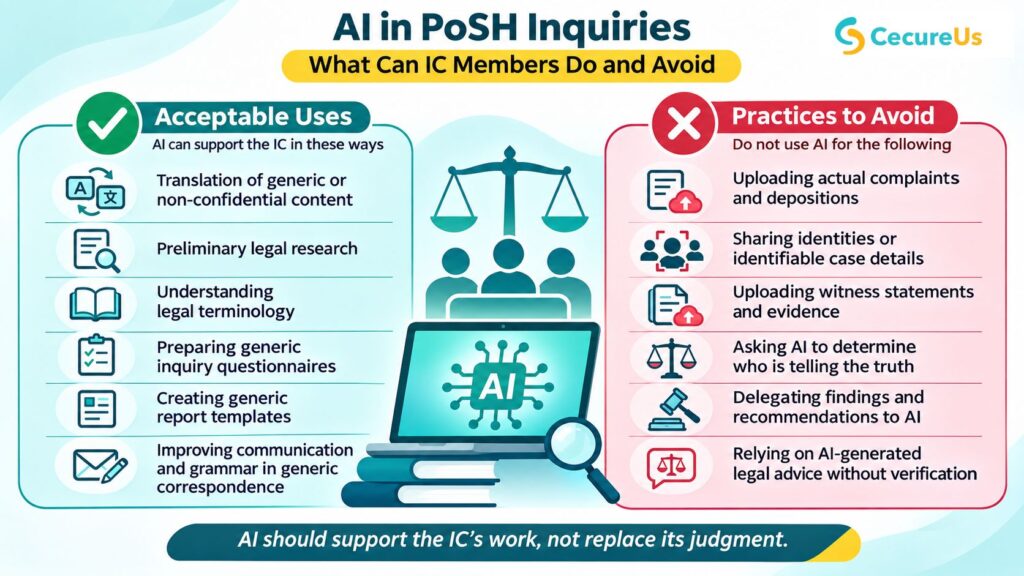
AI can be a useful supporting tool for IC members.
| Acceptable uses | Practices to avoid |
| Translation of generic or non-confidential content | Uploading actual complaints and depositions |
| Preliminary legal research | Sharing identities or identifiable case details |
| Understanding legal terminology | Uploading witness statements and evidence |
| Preparing generic inquiry questionnaires | Asking AI to determine who is telling the truth |
| Creating generic report templates | Delegating findings and recommendations to AI |
| Improving communication and grammar in generic correspondence | Relying on AI-generated legal advice without verification |
AI should support the IC’s work, not replace its judgment. All legal research generated by AI must be independently verified.
The Way Forward: Building AI-Ready Internal Committees
AI is here to stay. Rather than banning its use altogether, organisations must equip their Internal Committees to distinguish between responsible AI assistance and deliberate manipulation.
AI literacy, digital evidence verification, responsible AI usage and confidentiality safeguards should become integral discussion points during IC quarterly review meetings and capacity-building workshops.
AI can draft an argument, but it cannot establish the truth.
AI can assist an inquiry, but it cannot replace human judgment.
At CecureUs, we help organisations strengthen their Internal Committees through specialised PoSH training, quarterly review meetings, policy reviews and inquiry support.
Is your Internal Committee prepared to handle PoSH inquiries in the age of AI?
Connect with us at www.cecureus.com.
For more blogs and articles, visit our official website. Contact us for workshops and queries related to POSH, EAP (Employee Assistance Program) , Diversity and Inclusion and Code Of Conduct.